Advertisement
Nigel Farage has returned to Parliament after a decisive victory in Clacton.
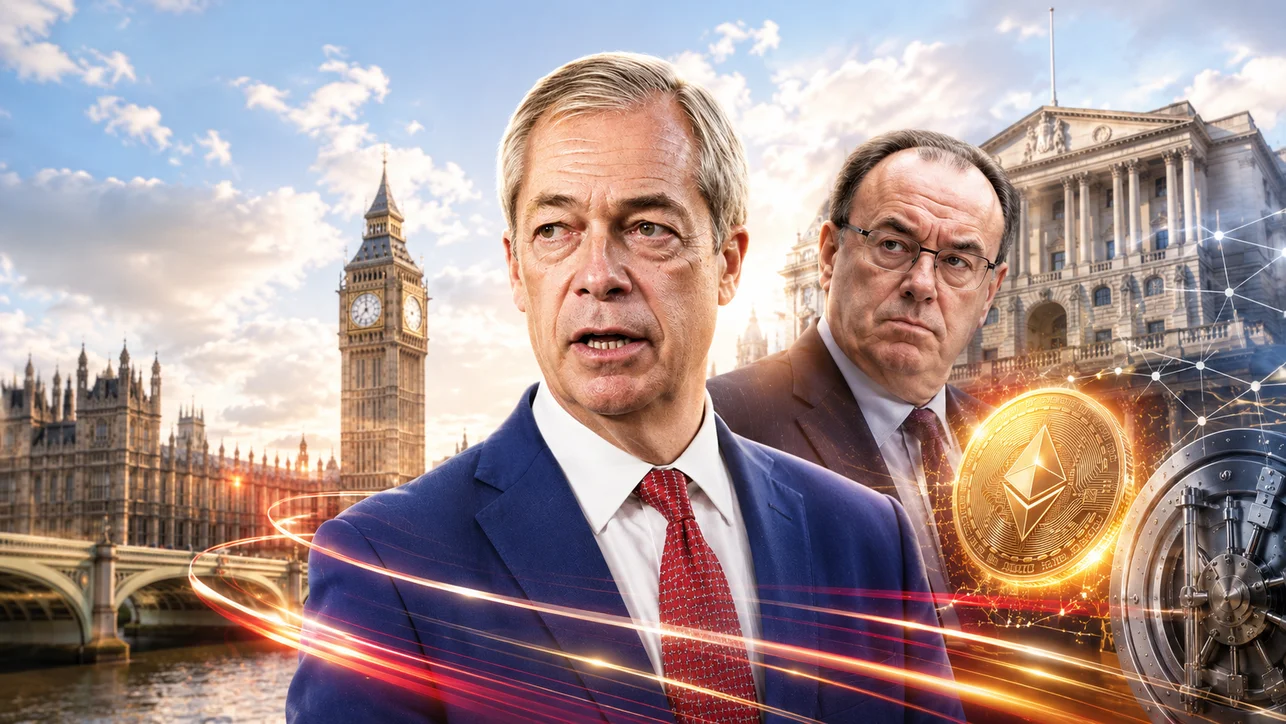
But the Reform UK leader is facing renewed questions over a remarkable chain of events involving a £5 million personal gift, Britain’s crypto rules and a private meeting with Bank of England Governor Andrew Bailey.
The key question is simple:
Why was Farage discussing stablecoin regulation with the country’s top financial official while his biggest donor was linked to one of the world’s most powerful crypto companies?
There is no finding that Farage broke the law or acted on behalf of Tether. Farage and Christopher Harborne have both said the money came with no strings attached.
But the timing of the meeting, the size of the donations and the financial interests involved have created a storm that Westminster has been unable to ignore.
THE DONOR BEHIND THE CRYPTO EMPIRE
Christopher Harborne is not an ordinary political donor.
He is a major shareholder in Tether, the company behind USDT — the world’s biggest stablecoin. Tether’s digital token is designed to maintain a value linked to the US dollar and is widely used as a bridge between the crypto market and traditional finance.
The company has become a giant in global finance. It is reported to hold vast quantities of US government debt and large reserves of gold, while operating with a remarkably small workforce compared with the scale of its business.
Harborne is understood to hold a substantial stake in the company.
He also donated £9 million to Reform UK in August last year, followed by another £3 million in October and £3 million in January. The donations were declared.
But the political controversy intensified after it emerged that Harborne had also given Farage a personal £5 million gift that was not registered at the time.
Farage has offered different explanations for the payment, describing it as an unconditional gift and saying it helped cover personal security and other costs.
The parliamentary standards investigation into the gift has now resumed following Farage’s return to Parliament.bbc.co+1
THE MEETING WITH ANDREW BAILEY
The most explosive part of the story centres on a conversation that took place between Farage and Andrew Bailey.
The Bank of England Governor has confirmed that Farage raised cryptocurrency regulation and central bank digital currencies during their meeting.
Farage reportedly made his position “very clear”.
He has long argued that Britain should embrace crypto and become a global centre for regulated digital finance. In a broadcast interview around the same period, he spoke enthusiastically about the scale of the stablecoin market and called for London to take a leading role.
The meeting took place while the Bank of England was considering tough restrictions on stablecoins.
Among the proposals under discussion were potential limits on how much individuals could hold — figures of between £10,000 and £20,000 had been reported during the consultation process.
For an industry built around the rapid expansion of digital currencies, restrictions of that kind could have had major commercial consequences.
That is why the conversation with Bailey matters.
Farage says he was expressing a long-standing policy position about the future of British crypto regulation. Reform insists that its policies were not shaped by individual donors.
The Bank Governor, meanwhile, has said he understands how to identify lobbying and knows how to take it into account.
But the question remains:
Was Farage simply arguing for a national policy — or could a change in British stablecoin rules also have benefited people connected to his biggest donor?
No evidence has established that Farage mentioned Tether directly during the meeting. That distinction is important.
Yet Tether was part of the wider financial background, and Harborne’s stake in the company made the potential conflict impossible to overlook.